An investigation of $p$-hacking in e-commerce A/B testing
Mixture modelsExpectation-maximizationMonte Carlo simulation
Overview
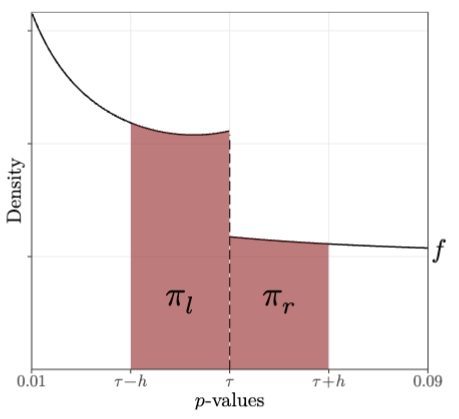
I designed and executed a study of 2,270 e-commerce A/B tests run by 242 firms to ask a simple but high-stakes question: Do practitioners p-hack? Answering it effectively required developing a new statistical tool—the asymmetric caliper test—which has Pareto-improving characteristics for investigating this question compared to off-the-shelf techniques. I used Python to implement the new test and fit a beta-uniform mixture model using expectation-maximization techniques. The final result is a large-scale peer-reviewed study that demonstrates $p$-hacking may be less common in real-world retail experimentation than previous evidence suggests.
Access the publication on INFORMS.org (.html)
Read the full manuscript with supplemental appendix here (.pdf)
How the Work Came Together
I led the research agenda from framing the question through gathering and processing the raw experimentation data, securing support from two research centers, and writing the resulting paper. The methodological challenge was that existing density-discontinuity tests were poorly matched to the shape of this dataset.
To address that problem, I developed the asymmetric caliper test and implemented an expectation-maximization algorithm to estimate it. More than 100,000 Monte Carlo counterfactuals show that the test can detect manipulation involving as few as roughly 3% of experiments at the available sample size. The work was ultimately published in Information Systems Research and presented at leading academic and practitioner conferences.
What the Research Found
We find no discontinuity at the platform's default 95% significance threshold, either among the experiments' target-metric $p$-values or across more than 16,000 $p$-values drawn from eight dashboard metrics. The result suggests that $p$-hacking may be less common in real-world retail experimentation than earlier evidence implies.
This null result is meaningful because the new test controls false positives better than a standard caliper test and has substantially higher power than off-the-shelf techniques such as rddensity for this setting. The broader implication is that organizational culture, incentives, and implementation experience may matter at least as much as statistical expertise in producing sound experimental practice.
Recognition & Impact
Journal Publication
Information Systems Research, Articles-in-Advance (Jan 2025)
Conference Presentations
- Conference on Information Systems & Technology – Seattle, WA
- Workshop on Information Systems & Economics – San Francisco, CA
- Conference on Digital Experimentation (CODE@MIT) – Cambridge, MA