Causal machine learning for personalized discount targeting with technographic trace data
Causal machine learningGradient-boosted treesOff-policy evaluationExplainability
Overview
I built a profit-oriented targeting framework for online discounts that learns to optimize over treatment-effect heterogeneity directly from A/B-test data. My framework optimizes both hyperparameter tuning and targeting-algorithm training for economically relevant objective functions, rather than off-the-shelf statistical objectives. Using data from 148k website sessions from two campaigns, I show how the method boosts expected profits by 3–6% versus best-practice baselines, entirely with technographic trace data (device, screen, browser, etc.).
How the Work Came Together
I developed this work end-to-end, from forming the research question and securing data from an experimentation platform through conducting the analysis in Python and authoring the paper. The modeling approach combines SVD feature engineering with LightGBM gradient-boosted trees to estimate heterogeneous profit lift while accommodating flexible discount and cost structures.
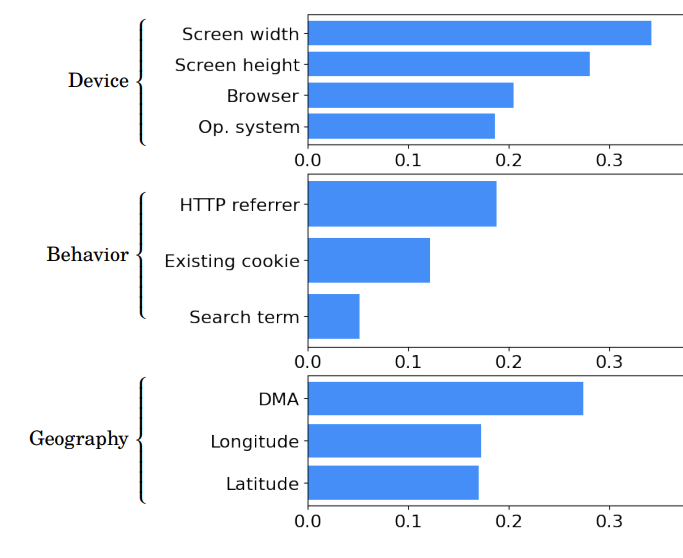
To evaluate the resulting targeting policies, I implemented doubly robust off-policy evaluation with Monte Carlo cross-validation. I also developed a grouped permutation importance technique that makes the model's recommendations interpretable and reveals how strongly device-level variables—including screen size, operating system, and browser—drive the profit signal.
What the Research Found
The central finding is that economically useful targeting must balance baseline purchase rates with treatment effects. Conventional uplift rules optimize the statistical signal but can leave money on the table when the underlying business objective is profit.
Across two firms, the optimized policy outperforms both uniform-discount and uplift-model baselines, producing an estimated 3–6% increase in profit. Geographic and behavioral variables contribute to predictive accuracy, but basic device characteristics—screen size, operating system, and browser—account for most of the policy's incremental value.
Recognition & Impact
Conference Presentations
- Conference on Information Systems & Technology – Virtual
- Conference on Statistical Challenges in E-commerce Research – Virtual
- International Conference on Information Systems, Virtual
Best Short Paper in Track, 2nd Runner-up
International Conference on Information Systems, 2020