Improving recommendation diversity with probabilistic item selection
Recommender systemsCollaborative filteringAgent-based simulationMathematical modeling
Overview
Along with my advisor and collaborator, Kartik Hosanagar, we developed and studied what we call Probabilistic Item Selection (PI)—a drop-in replacement for the “top-item” step in $k$-nearest-neighbor collaborative filtering that samples recommendations with probabilities proportional to item popularity among nearest neighbors, rather than always picking the single most popular item. A dynamic agent-based simulation and an empirical study on archival data from 1,830 users × 522 artists from LastFM show PI boosts diversity while preserving accuracy.
How the Work Came Together
Working with my advisor, I helped establish the theoretical behavior of probabilistic item selection and prove that, under mild assumptions, it converges toward the unbiased preference distribution rather than reinforcing popularity bias. I then adapted the existing MATLAB model to test the algorithm in a dynamic agent-based simulation, using the university's grid-computing infrastructure to run the analysis at scale.
I also implemented collaborative-filtering recommenders in Python for an offline empirical evaluation using the LastFM dataset. Together, the analytical model, simulation, and archival-data study allowed us to test the same mechanism from three complementary directions. I presented the results at WITS 2017 in Seoul and CIST 2017 in Houston, and the work was offered a fast-track review by an editor at ACM TMIS.
What the Research Found
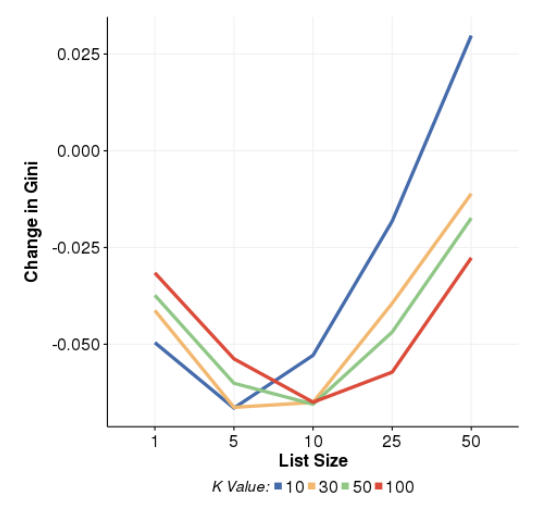
Probabilistic item selection reduces the Gini coefficient of the item-sales distribution by roughly 10% while matching or improving forecasted consumption. This produces a Pareto improvement: recommendation diversity increases without requiring the usual sacrifice in predictive accuracy.
The technique also complements rather than replaces existing diversity interventions. Combining PI with other diversity-increasing methods produces a super-additive increase in sales diversity. The analytical model explains why the mechanism avoids the “rich-get-richer” loop of deterministic recommenders, while both the simulation and the LastFM evaluation confirm that the effect persists in more realistic settings.
Recognition & Impact
Conference Presentations
- Workshop on Information Systems & Technologies (WITS)– Seoul, Korea
- Conference on Information Systems & Technology (CIST) – Houston, TX